What is a Biological Signature?
A fingerprint is a few features that stand in for a whole person. Finding one in a dataset is feature selection.
This article was originally published on the Project Delphi ML Blog.
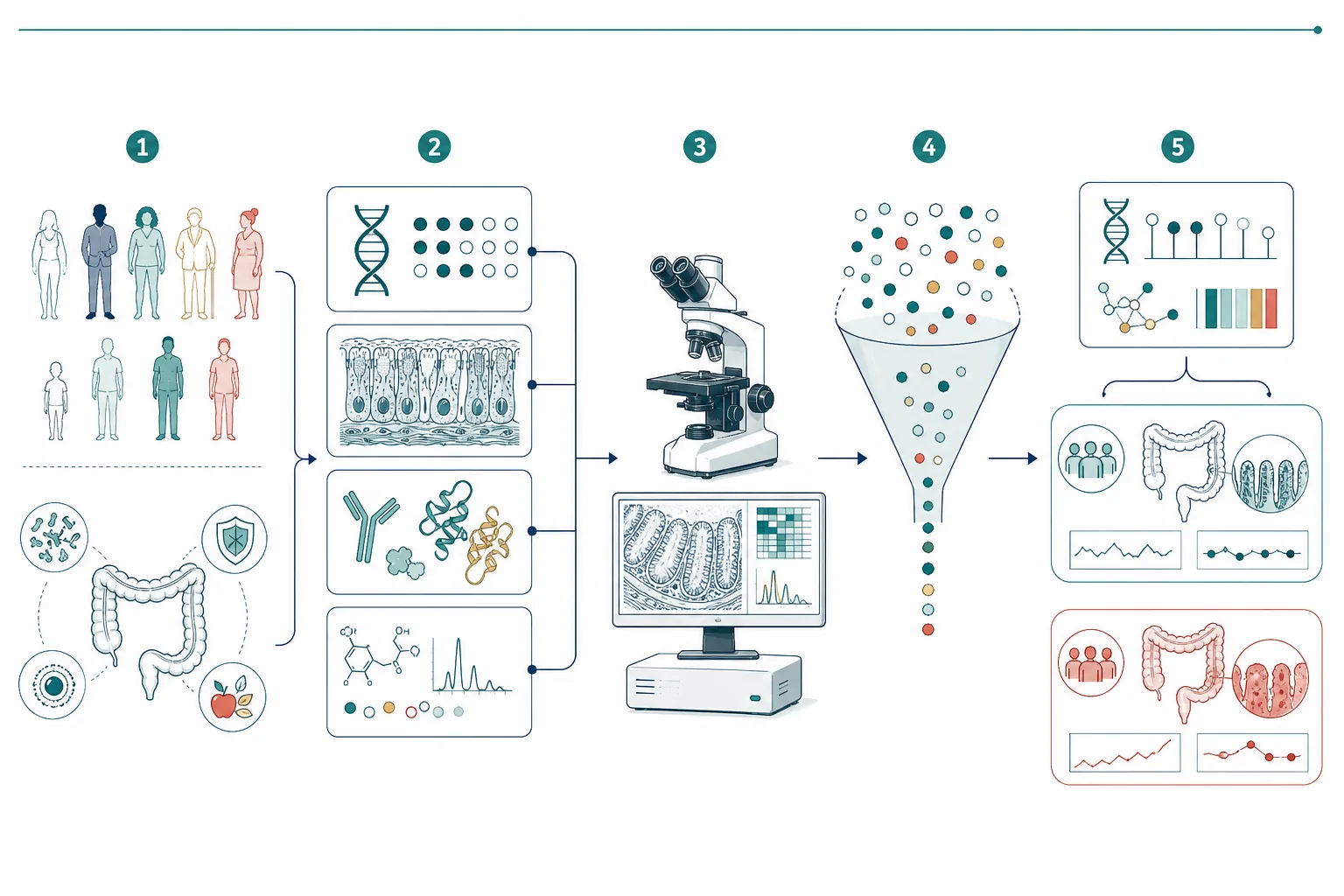
A signature is a short list of measured molecular features (genes, proteins, or metabolites) that distinguishes one condition from another.
It is feature selection on wide, small-\(n\) data: tens of thousands of genes, tens of patients. A model given all features will fit noise.
1 Procedure
- Measure wide. Every feature on every sample.
- Find the groups. Use known labels, or let clustering propose groups.
- Select. Score features by group separation:
- \(t\)-test: distance between group means relative to within-group scatter.
- Mutual information: how much the feature tells you about group membership.
- Penalized models (lasso, elastic net): drop features by charging a cost for each one used.
- Validate on held-out data. Redo selection inside each cross-validation fold.
Selecting on all samples, then testing on a “held-out” subset, leaks the selection. Ambroise and McLachlan (2002) showed that this bias drives reported error toward zero; nested selection raises it again.
Leaky validation
Too optimistic: the held-out samples already influenced which features were chosen.
Honest validation
Defensible: every fold repeats selection before the untouched samples are evaluated.
2 Canonical example: Golub leukemia
ALL and AML are two acute leukemias that look similar under a microscope and take opposite chemotherapies. Diagnosis used to rest on four specialist lab tests.
Golub et al. (1999) measured 6,817 genes in 38 acute-leukemia samples.
- Unsupervised clustering, given no disease labels, nearly recovered the split (one group 24 ALL + 1 AML; the other 10 AML + 3 ALL).
- A 50-gene predictor was then tested on 34 independent samples from other banks.
Fifty features out of 6,817 is a signature.
The same four steps apply to environmental DNA (a few marker sequences implying a species was present) and to exoplanet spectra (gases inconsistent with abiotic chemistry).
3 References
- Ambroise, C. & McLachlan, G. J. (2002). Selection bias in gene extraction on the basis of microarray gene-expression data. PNAS.
- Golub, T. R. et al. (1999). Molecular classification of cancer: class discovery and class prediction by gene expression monitoring. Science 286(5439):531–537.
- Guyon, I. & Elisseeff, A. (2003). An introduction to variable and feature selection. JMLR.
- Meinshausen, N. & Bühlmann, P. (2010). Stability selection. JRSS-B.