flowchart LR
  UC["Ulcerative colitis<br/>persistent inflammation"] --> S["Paired biological view"]
  S --> P["Plasma cfDNA<br/>methylation"]
  S --> T["Colonic tissue<br/>methylation"]
  S --> I["Serum sIgA +<br/>inflammation markers"]
  P --> X["Integrated association<br/>analysis"]
  T --> X
  I --> X
  C["Healthy + CRC<br/>comparators"] --> X
  X --> O["Candidate signatures for<br/>risk stratification"]

  classDef source fill:#e9f5f2,stroke:#167d78,color:#123b5d;
  classDef assay fill:#f7efe1,stroke:#c58b2c,color:#3c2d16;
  classDef outcome fill:#123b5d,stroke:#123b5d,color:#fff;
  class UC,C source;
  class P,T,I assay;
  class S,X,O outcome;
Colitis at Molecular Resolution
Paired tissue and plasma DNA methylation with serum sIgA across high-risk ulcerative colitis, colorectal cancer, and healthy comparators.
TRANSLATIONAL EPIGENETICS · COLOMBIA
Tissue, plasma, and immunity.
One molecular view of colitis.
We are studying whether paired tissue and plasma DNA methylation and serum secretory immunoglobulin A (sIgA) reveal a coherent disease-state fingerprint across high-risk ulcerative colitis, colorectal cancer, and healthy comparators.
PROJECT EXPLAINER · 4 MIN 41 SEC
Begin with the biological story
See how chronic inflammation, methylation, plasma cfDNA, and sIgA connect—then explore the study in depth.

Rooted in cellular and molecular immunology
This project sits within the scientific environment of InMubo, the Cellular and Molecular Immunology Research Group at Universidad El Bosque, whose work spans cancer immunology, mucosal immunity and infection, autoimmunity, systemic inflammation, and new research technologies.
COLOMBIA · GLOBOCAN 2024
Cancer burden in national context
IARC estimates 123,053 new cancer cases and 55,981 cancer deaths in Colombia in 2024. Colorectal cancer ranks third by new cases in both sexes—an important national backdrop for this project’s focus on colitis-associated progression.
COLORECTAL CANCER 11,153 new cases · 3rd most frequent 5,519 deaths · 3rd leading cause of cancer death
123,053
new cases
55,981
deaths
309,071
people alive within 5 years of diagnosis
Five most frequent cancers by new cases
Source: International Agency for Research on Cancer, Global Cancer Observatory — Colombia fact sheet and Cancer Today interactive visualization. GLOBOCAN figures are estimates, not observed case counts.
The question behind the project
Long-standing ulcerative colitis creates a setting of persistent inflammation, epithelial injury, repair, and—in some patients—neoplastic transformation. Current surveillance is essential, but the project asks whether molecular signals in blood and colon tissue can add a more biologically informative layer.
01
DNA methylation
An epigenetic record of gene regulation and cellular state. The project compares methylation profiles in plasma cell-free DNA and colonic tissue across ulcerative colitis, colorectal cancer, and healthy comparator groups.
Integrated interpretation
Do immune dysfunction and epigenetic change move together—and does their combination distinguish higher-risk biology?
02
Secretory IgA
A mucosal immune signal involved in limiting exposure to commensal microbes and shaping intestinal immune responses. The study examines serum sIgA alongside methylation and inflammatory markers.
Explore how the two data streams are produced → · Understand the sIgA assay and rationale →
Study at a glance
18
participants planned
3
comparison groups
36
paired specimens
1
integrated risk model
ImportantStudy status
This site describes the rationale, planned design, and expected analytical framework presented by the research team. Candidate biomarkers remain hypotheses until validated; the site does not present clinical guidance or a diagnostic test.
Explore the work
Study design
Research question, cohorts, specimens, objectives, ethics, and analysis plan.
Two-source comparison
What methylation and sIgA reveal independently—and why integration matters.
Research landscape
Connect this Colombian project with complementary IBD programs worldwide.
Check your understanding
Thirty questions on the candidate genes, the sIgA assay, pathway enrichment, the statistics, and the clinical setting—each answer explained and linked back to the note it came from.
From the Field Notes
Practical, illustrated explainers connect the study design to the wider cfDNA field.
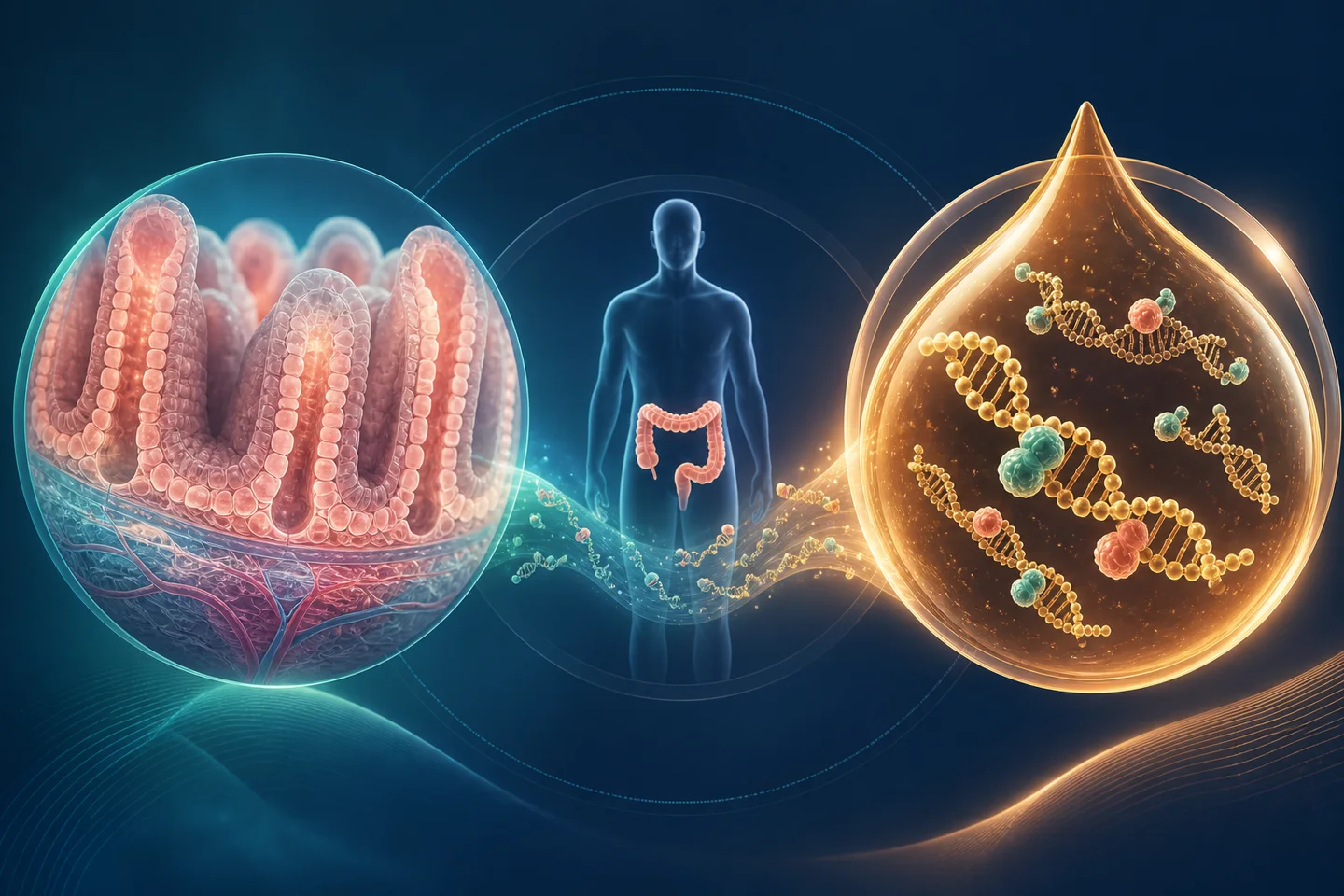
Why pair tissue and plasma?
See how anatomical context, liquid biopsy, fragmentomics, and sIgA triangulate a candidate disease-state signal.

How leading labs analyze cfDNA
Compare the feature engineering, statistical models, machine learning, and validation logic used across major programs.

Packages for disease fingerprinting
Choose a reproducible stack for EM-seq, fragment features, pathways, integration, and future longitudinal models.
New to the assay? Start with the illustrated EM-seq explainer →
Curious about the physical DNA signal? Read the short fragmentomics explainer →
For the clinical context, read how long-standing colitis can progress toward colorectal cancer →
For the mechanism, explore how inflammation can reshape DNA methylation →
For the candidate biology, review which silenced and inflammatory genes appear in the project evidence →
For analysis, see how the software stack evolved from limma to fragmentomics → and how beta-binomial and regional procedures work →
For a deeper statistical treatment, compare limma’s moderated linear models with DSS’s beta-binomial approach →
For biological interpretation, start with what KEGG is → and how Reactome represents pathways →
For the immune signal, read the plain-language guide to what sIgA is and why the study tracks it →
Want to check what stuck? Take the 30-question quiz →